Learning Italiano

We have been serious about learning Italian since we first explored the idea of moving to Italy. However, I can say without any hesitation, that it is one of the most difficult things I have ever tried to do. It is amazing to me to find that I could work on something each and every day and still not master it. I started my language learning experience with no previous exposure to Italian. I had a couple of mandatory semesters of Spanish in high school but after graduating I promptly forgot all of it. Dave had a slightly stronger Spanish foundation, but nothing substantial that would provide meaningful support for learning Italian.  

About a year before our anticipated move to Italy, we both began preparing for the transition. We started with the purchase of Rosetta Stone. We used it religiously for 30 minutes every day for a few weeks. Then we got bored with the lack of progress. We moved on to try another program, Duolingo. We ran into the same situation. Then I read Fluent Forever and was quickly sold on Gabriel Wyner’s method of language learning which included Spaced Repetition System (SRS). This included referring to thousands of flashcards in an ingenious program called Anki. We started private lessons to get us on our way. Interestingly, all of the teachers we worked with throughout the process were named Francesca!   

After I purchased an Italian grammar book  I began to realize just how little English grammar I really understood. In addition to private lessons that we started after arriving in Italy, we also enrolled in a series of intensive language courses, investing three to four hours per day for two weeks at a time. We bought more Italian books to read, listened to Italian language-learning podcasts (Coffee Break Italian and Podcast Italiano are my favorites!), listened to daily news (www.easyitaliannews.com), tried several lessons on Italki, and added in some Speak conversation classes.  

Yet despite all this effort, I will reiterate that this is the most difficult thing I have ever tried to do in my adult life! The reality is, that even though we chose Turin as our destination because we were drawn to a city where the residents spoke “less English”, we soon find out that most of the people we met spoke English much more comfortably than we spoke Italian. The Italians here are famous for saying, “I don’t speak English very well”. However, by just being able to communicate that one articulate thought, they have already proven that they can form a complete comprehensible sentence. Accomplishing this seemingly simple goal is something I am still struggling with a year into this experience.  

Now, it’s important in the context of this topic to differentiate between “functional” vs. “conversational” language skills. I believe that Dave and I became “functional” in Italian about six months into living in Italy. I can reasonably get through any situation (even signing up for a cell phone plan independently). We understand most of what people are saying and can communicate slowly with them – and be understood.  

My personal goal since moving to Italy has been to get more fluent when conducting a conversation. 

This is proving to be an ever-expanding task that I’m honestly not sure if I will achieve in the three years we are here. I want to be able to have general conversations with people. I want to be funny and ironic and to be able to tell interesting stories. Mostly, I want to be able to express emotion. 

I believe my biggest roadblock has been the blessing that I have made many English-speaking friends. As such I am rarely forced into relying solely on Italian conversation. And even when I’m trying, well-meaning people encourage me to speak English instead. Unfortunately, the path of least resistance has consistently been my choice as I defer to English over struggling with Italian. My hope is that when I discover the magic solution, I will update this post! 

One final thought that I’ve really embraced and come to understand is that, like many things in life, learning a language does not occur as a straight line on a well-defined path. There are not only ups and downs, but also there are periods of stagnation and periods of exponential growth. There are times when I feel unstoppable and periods when I am not able to make myself understood even when just making a very simple statement I have made. In fact, it is only recently I have stopped automatically beginning every conversation with “Hello, I’m sorry I don’t speak Italian very well but …..”.  

By the way, I stopped using this as my opening line after my Italian friend said “Lynn, all you have to say is ‘buongiorno’ and we immediately know that you don’t speak Italian very well!” (ha, ha).  

Well, obviously, I have more work to do! But I refuse to throw in l’asciugamano (that translates as ‘towel’ – of course!) 

Gelato Culture

I love gelato. Love it. But I have to admit that this is not a new love that developed since arriving in Italy. I have always liked ice cream. One summer while we were living in Chicago, our family made it our mission to visit all of the top 10 ice cream places in the city as designated by Time Out. Of course, we succeeded even though many were in the far reaches of the city. And not only did we try the ice cream everywhere, but like all good researchers, we assessed and analyzed each one of them.

I knew that Italy was famous for its gelato and I knew it would be really good. I recalled our honeymoon when Dave and I visited three different gelato places in Florence in just one day. We ordered the same flavors so that we could accurately assess and analyze each place. What I never understood prior to moving here though was the difference in the gelato culture. I never even understood that there was such a thing as a “gelato culture.”

In Italy, gelato is not necessarily recognized only as a dessert or a treat. It is not seen as the next course after dinner or a reward after winning a baseball game. And it is certainly not mostly for the children. What has struck me most is this concept of gelato as being the “perfect snack.” While it is popular as a “merenda”, an afternoon snack between 4:00-6:00 pm to carry you over until aperativo hour, it really is appropriate to eat gelato at any time of the day. It is also appropriate to be enjoyed by anybody, in anybody’s company, or even when alone.

Walking through various towns, I often see men dressed in corporate business suits enjoying a gelato-filled cone in the afternoon, an old lady sitting on a park bench enjoying a cup in the late morning, or a 40-year woman without children pausing in the middle of her shopping for a gelato break. Literally, anybody can have a quick gelato. And society is okay with it. 

Also, the cups and cones are small and inexpensive. We usually order two flavors for €2 (or maybe €2.50 if it’s a really well-known establishment). Gelato is literally meant to be enjoyed daily. I once had an Italian language teacher tell me that he routinely eats two to three gelatos per day in the summertime (while he acknowledged that in the winter, it’s only once per day). 

It’s worth noting here that gelato is very different from ice cream. 

While both have the essential ingredients of milk, cream, and sugar, ice cream also traditionally includes egg yolks. Ice cream has a lot of air whipped into it and it is served at a very low temperature. Instead, gelato contains a higher percentage of milk than cream, with very little air, and is served at a warmer temperature. The end result is a product that is silkier and softer. Since the fat content is lower, the primary flavor generally shines through more robustly. Making good gelato (like most cooking) is both a science and an art – and of course, the Italians think they are best at it. If you want to learn from the best, you can attend Gelato University in Bologna as we did. Although you may prefer to attend the four-week course, we just attended the afternoon class and concentrated our full attention instead on mainly eating the gelato! 

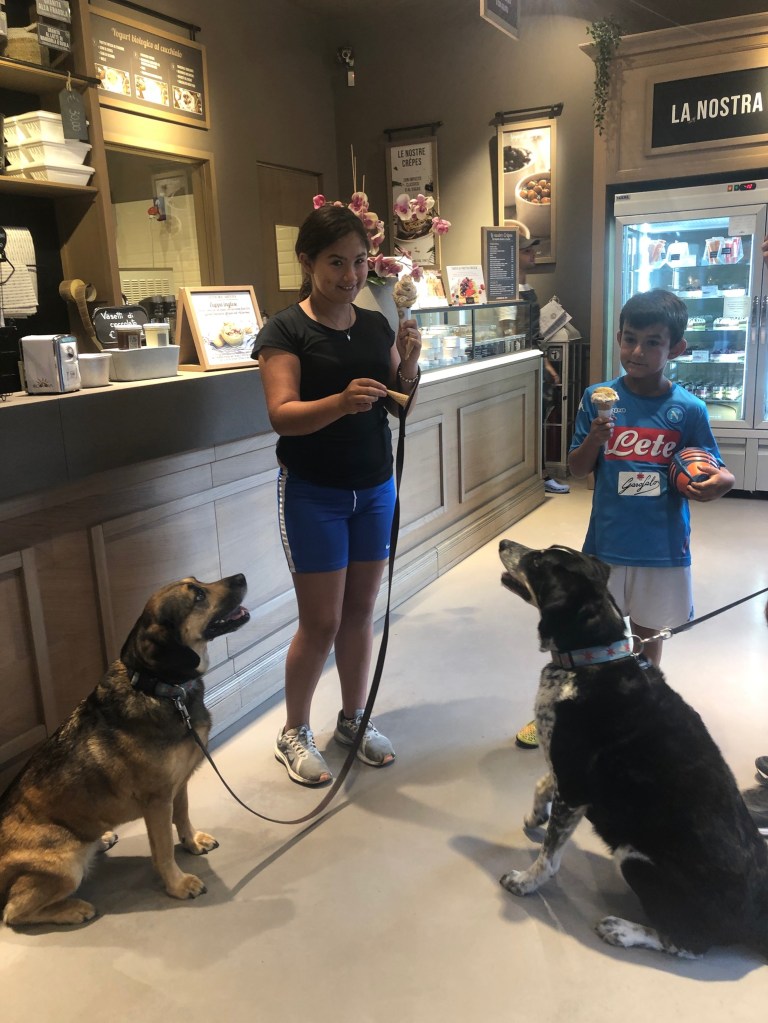
Although it is possible to get good gelato everywhere throughout Italy, our family has definitely chosen a favorite. We LOVE La Romana. This is a small franchise in Italy that started in Verona. There are four locations in Turin so it’s always convenient for us to stop by for a quick “merenda.” It is a slight deviation from the classic Italian gelato in that there are chunks of ingredients (à la Ben & Jerry’s famous style) and they also sometimes have Arachide (peanut butter) as an option – which is a favorite in our family. It’s an unusual flavor to find in Italy, so I once asked a woman working at a gelato place in Elba whether Italians themselves actually order arachide, but she told me it was prepared just for foreign tourists!  That may be, but in the Lewin household, we still love it.

In the end, we think we will miss gelato so much when we move back to Chicago we want to bring it with us. We have seriously (and half-heartedly jokingly) discussed launching a La Romana franchise in Chicago. The idea generated in part to fuel our own gelato craving, but also to bring this incredible treat to the United States. We do not want to just encourage Americans to love great gelato, but more so we want to introduce the “idea” of gelato, helping to cultivate a genuine “gelato culture.”  

That’s the really good stuff that makes Italy so unique that I want to spread and share. 

Granita in Sicily

I haven’t thought much about granita in a couple of years, really since the last time we were in Sicily. But now that we are here again, I am reminded of just what a unique, refreshingly perfect treat it is. Although water ice in the United States stems from granita in its basic form, it is quite different. I grew up eating Rita’s Water Ice. It was a pretty special treat we had in Philadelphia. I find granita to be much creamier and chunkier than the water ice I remember. And the flavor choices are so different.

One thing I have learned to love (and to roll my eyes) about Italians is their firm belief that they know the best way to eat. The Italians have a unique protocol in place for eating.  From requesting dishes out of the correct order at a restaurant God forbid, or if you don’t order all three courses, or if you ask for a salad as an appetizer, or the absolute worst faux pas is to request coffee before having dessert – these are all worthy of Italian disdain. The culture in Italy encourages everyone to provide strong opinions on the best of everything.  Italians really take pride in their products. For this reason, we will always remember when Kai was severely reprimanded, and ultimately denied when he asked for a granita with chocolate and lemon flavors. The older gentleman serving us simply stated that those flavors did not go well together and he would not serve it to him. Kai confusedly and grumpily chose a different combination. The server simply could not bring himself to give Kai something that he didn’t think would result in a delicious taste experience!

Since that time, it has become somewhat of an inside joke. Kai has continued to order this combination at almost every granita place he has gone, adamantly believes the flavors taste great together, and nobody has since denied him this request. However, I will admit that even to this day, the place that denied him his choice had the best granita we encountered… 

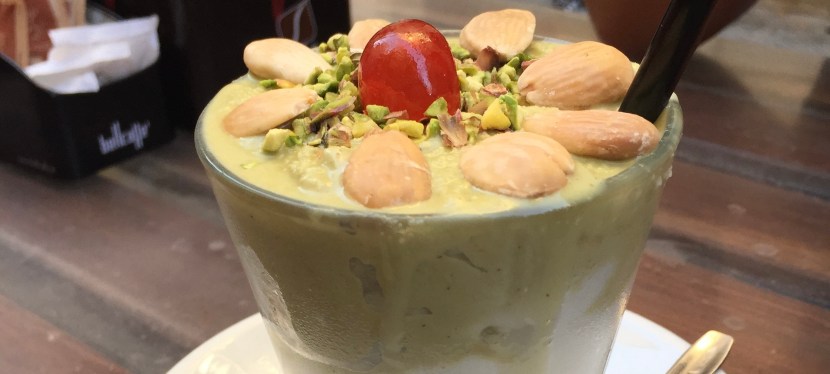
We just never felt like we had enough granita!. We ate it every day on a recent trip to the Aeolian Islands of Salina in Sicily. Seriously, every day! Sicilians often eat it with a thick bready brioche for breakfast, it’s the perfect refreshing afternoon snack or an easy dessert after dinner. There is never a bad time for having granita. The flavor options are more extensive than the limited choices of water ice of my youth in Philadelphia. While lemon and strawberry are common, they almost always have nut favors available as well – pistachio, almond, coffee, and chocolate flavors. The most famous flavor unique to Sicily is gelsi – a wild huckleberry. The perfect granita is thick and creamy with a chunky texture. It is eaten in a cup with a spoon and we learned to eat it slowly and take small bites because it is served so cold. 

To be honest, I don’t know why it’s not replicated around the world, or even just in other parts of Italy. We have granita in Turin, but I will be the first to say it’s not the same. My best guess is that it’s hard to replicate for three reasons: it is part technique, part fresh ingredients (the fruit, almonds and more come right from Sicily), and part demand. Granita is something the people of that region like to eat. We have learned that Italians tend not to stray outside of eating foods that their region is known for. But, if I could figure out how to bring granita back to the United States with me when we return, I definitely would! 

Starting at an Italian School

We were so fortunate in our first year of this journey to find a school where our kids were happy. 

Our children started at the International School of Turin in the nearby small town of Chieri. It’s an international baccalaureate school (PK-12) and they experienced almost no transition at all. Their peers were accustomed to meeting new kids frequently and there were systems in place (assigning buddies, attending workshops, etc.) designed to make them feel welcome from Day One. For us, one great advantage was that it is a school that is definitely focused on “free-thinking”. I always felt the school was producing “game changers” – a vision they accomplish by posing difficult questions to their students and encouraging a response that reflects a truly international focus.  

However, as the year evolved, we found ourselves increasingly concerned that by keeping them enrolled at this school, we were not going to be able to provide a truly immersive experience. Aside from a few hours of Italian per week, the school was conducted completely in English. The majority of their friends (and subsequently our friends) were Expats who had moved to Italy from English-speaking countries.  The only true Italian they were getting was from their respective soccer teams, on the playground, or during their weekly one-hour session spent with an Italian tutor.   

By the spring of our first year, this served as the catalyst that pushed us to start to look into other options. We again considered Spinelli, a public international school (that we had come across during our first search of schools in Turin. Because at the time we were making inquiries from Chicago, with very little understanding of Italian, we did not really understand what the school offered and whether or not it was a viable option for our children.  

But over the first ten months of living in Italy, our language skills greatly improved, and we were able to schedule tours of the primary and secondary schools, as well as successfully understand the process for submitting an application. The procedure was incredibly confusing to us, but we continued to move on with very little information along the way and were excited to finally find out in July that they had space for all three of our children. Our kids showed mixed levels of excitement. And in reality, their feelings changed from day-to-day. At first, our oldest, Ali was excited to go, but on the actual first day of school, she was so anxious that she was crying outside of the classroom and wouldn’t go in. Meanwhile, Joy, our youngest, wasn’t sure she wanted to go, but on the first day of school, instantly met an outgoing Australian girl and walked right in. All three came home from the first day excited, happy, and talking nonstop. We needed another parent so tall three could talk at once!  

Of course, there have been ups and downs along the way. We’ve experienced times when they were frustrated, nervous, scared, and just plain angry. By December, they were all understanding and speaking Italian (even stubborn little Joy) and we can say genuinely they are happy. It was this positive school experience that solidified our decision to remain for a third year. We want each of our children to experience a year when they are not seen and judged and treated as the ‘new kids.’ We want them to gain the full advantage of being truly comfortable in their surroundings, developing deep friendships, being immersed in the language, and having fun.  

Coffee Culture

I don’t know how I’m ever going to go back to Starbucks again…

I’m a coffee lover. I have been ever since I relied on it so heavily when I was studying late into the night in veterinary school.

My first experience ever with an Italian-style coffee shop occurred around 2006 in Philadelphia in a small shop called “La Colombe” in Rittenhouse Square Philadelphia. A friend encouraged me to check out this cool new shop and since I was constantly on the look for somewhere new to cram countless amounts of veterinary material into my brain and coffee into my veins, I decided to check it out. I walked in and was immediately confused. Instead of a big counter with a menu behind it and people sitting at tables with computers and books (i.e. Starbucks), I felt like I had walked into an old beautiful estate, with a high wooden beautifully polished counter, china cups on the bar, people sitting at small tables with a friend deep in conversation and mostly I noticed he deep aroma of freshly brewed coffee.

A dire il vero (to tell you the truth), I walked right back out. I didn’t know what to order. I didn’t think I could/should study there, and I was generally overwhelmed. I went back to my Starbucks-like coffee shop down the street and wouldn’t think too much again about La Colombe for a number of years.

I always think back to that first experience with La Colombe because if I had had any appreciation for the Italian way, I would have understood and embraced the entire setup. There is a coffee shop here on every block, which they call a ‘bar’. It always has the same basic structure. It typically has an old-style feel and is inviting and warm. You are quickly greeted with a “Buongiorno”, followed by a “Dimmi” (tell me). Italians know what they want to order (without a menu) and the coffee is quickly placed on the bar for you to drink and leave or for you to take to a nearby small table, where you are welcome to stay for as long as you would like, chatting with friends or reading the newspaper. An espresso is generally 1€ (same for an americano if you prefer the extra water), maybe 1.30€ for a cappuccino, and 2€ if you need a little more and order a double macchiato (two shots of espresso with a bit of foamed milk). Every Tuesday and Thursday, I meet with the same group of women to have coffee after a yoga class. We stay for an hour chatting, while I enjoy one of the best cappuccinos I have ever had at a quiet little bar (it’s not hip or trendy like US coffee shops). At the end, I leave my 1.30€ and go.

I would also note here that because you find multiple coffee bars on every street, it is an ideal spot when you are moving around to use the bathroom.  For 1€, you and/or your kids can use a nice clean bathroom and you get an espresso out of the deal. They also almost always have small sandwiches and simple cocktails if you are looking for something more. 

It is a normal Italian practice to generously offer a coffee to those around you. When I was getting to know some of the parents on Ali or Kai’s soccer team, they were always quick to offer me a coffee while we were waiting for the game to start. It’s an activity that can and does occur multiple times throughout the day.  When you go to the coffee shop in any small town, you often see gatherings of older folks at any time of the day. It’s a part of the daily culture here and it is so easy to enjoy.

I did come back to La Colombe years later, but after they had “American-ized” and started opening several other shops in Philadelphia and then in Chicago (where we moved in 2009). They now had menus, a smaller “bar”, and lots of inviting spaces to sit and study. On a recent trip back to Chicago, I tried to recreate my Italian coffee shop experience at La Colombe in the West Loop and it was an utter failure. I ordered a macchiato, which was oversized and full of too much milk. I tried to stand at the bar and enjoy my drink, but was constantly pushed out of the way by a crowd of people grabbing their lattes in to-go cups. I also tried my usual grande latte at Starbucks. It was $5.50, too hot, burnt-tasting and full of milk. 

Going back will be an adjustment.

Also, check out our write-up of the Lavazza Museum.  It’s one of our favorite museums in the area and is a fascinating place to interact with the story of coffee in Italy (even the kids love it).

How I Learned To Slow Down and Embrace the Italian Way of Shopping

I’m not going to lie, living without Target (or similar store) is quite an adjustment. And I haven’t even really adjusted completely yet. I’m embarrassed to admit that I spent over $500 there on a trip back to the United States last November. Although there are similar big box stores for home improvement, clothes, and sporting equipment (Leroy Merlin, H&M, Decathlon), there really is not a store like Target for all the home essentials here in Italy. There are large supermarkets, like the IperCoop, with a fair amount of non-food items, but the depth and breadth of the selection are not even close. Even more interesting is that even if there was a Target here, it’s not really the way in which Italians do their shopping. They prefer to do their shopping at small stores within their villages or cities.

That is the charm of living in Italy. The products tend to be of higher quality because they are not mass-produced to be as cheap as possible and in some regards, this way of shopping can actually be quite easy and convenient. For example, the only way I have bought a lightbulb since arriving in Italy is by taking the dead lightbulb to our local hardware store and asking for a replacement. I’m sure to always go home with the correct bulb. 

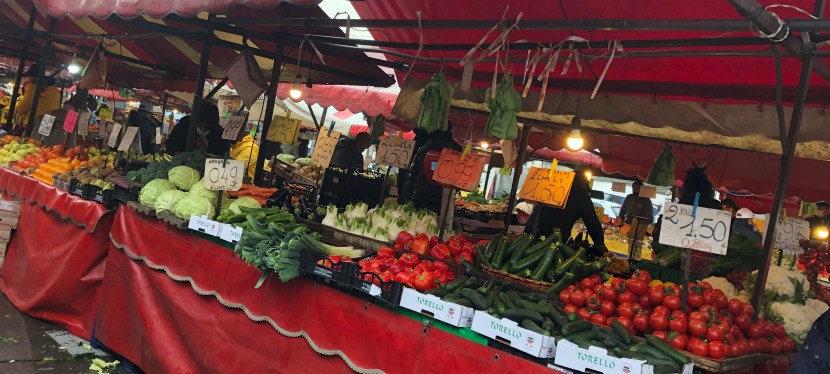
And the personal touch of shopping this way is a real benefit. My butcher knows what I like. When I ask for pork shoulder, he pulls out ¼ pig, slaps in on the counter, and inquires about what I am making. After understanding it’s for a soup, he cuts the best aspects of the meat for this. And then he’ll cut or grind it exactly how I need it. The shopkeepers often throw in “un regalo” (a gift), like a few extra eggs (from my egg lady who has a chicken farm just outside of Torino where her chickens lay 20 different kinds of eggs) or an extra avocado from the woman at her stand in the Porta Palazzo market who is the only one in Torino I have found that offers consistently delicious mangoes and avocados. And when I went through my sourdough bread making phase, like many of us did during quarantine, the woman at my dry goods store (which sells mainly beans, rice, and flour) was incredibly knowledgeable and helpful with all my experimentation.

But in other ways, shopping is much more difficult. The hardest thing for an outsider is that you have to find the exact small store that might have what you are looking for. For example, I need printer ink. Do I go to: a) stationary store, b) a hardware store, or c) a tabaccheria? Trick question, d) none of the above, you go to a printer ink store, of course. Then, you have to make sure they are open (most stores in Italy are open in the morning and in the evening – with a 3-4 hour break for lunch). Finally, you have to be able to ask the shop owner for what you need. And be prepared for the fact that everything is going to take longer. There’s no such thing and being in-and-out in 5 minutes (the person in front of you is paying slowly in cash and likely has asked how the cashier’s family is doing). 

And what used to be one shopping visit to Whole Foods in Chicago is now a visit to the fruit & vegetable market, the butcher, the cheese shop, the dry goods store, and maybe a quick stop to the small grocery for some other items. And deciding between all new brands and reading labels in a foreign language takes some getting used to, and means more time spent at the stores.

All in all, I’ve tremendously come to appreciate this kind of shopping. I love that almost all of our food is local and organic and is a fraction of the cost as in the States. I love the personal touch and the relationships you form when you visit the same small businesses over and over again. It makes me sad to see how much Amazon has grown its presence. It really took off during the lockdown and is making it more difficult for the little shops.

But, don’t get me wrong, Target will still be one of the first places I will visit on my next trip back to the US. The impatient side of me still longs for the convenience of buying milk, printer ink, and a pillow in one easy trip.

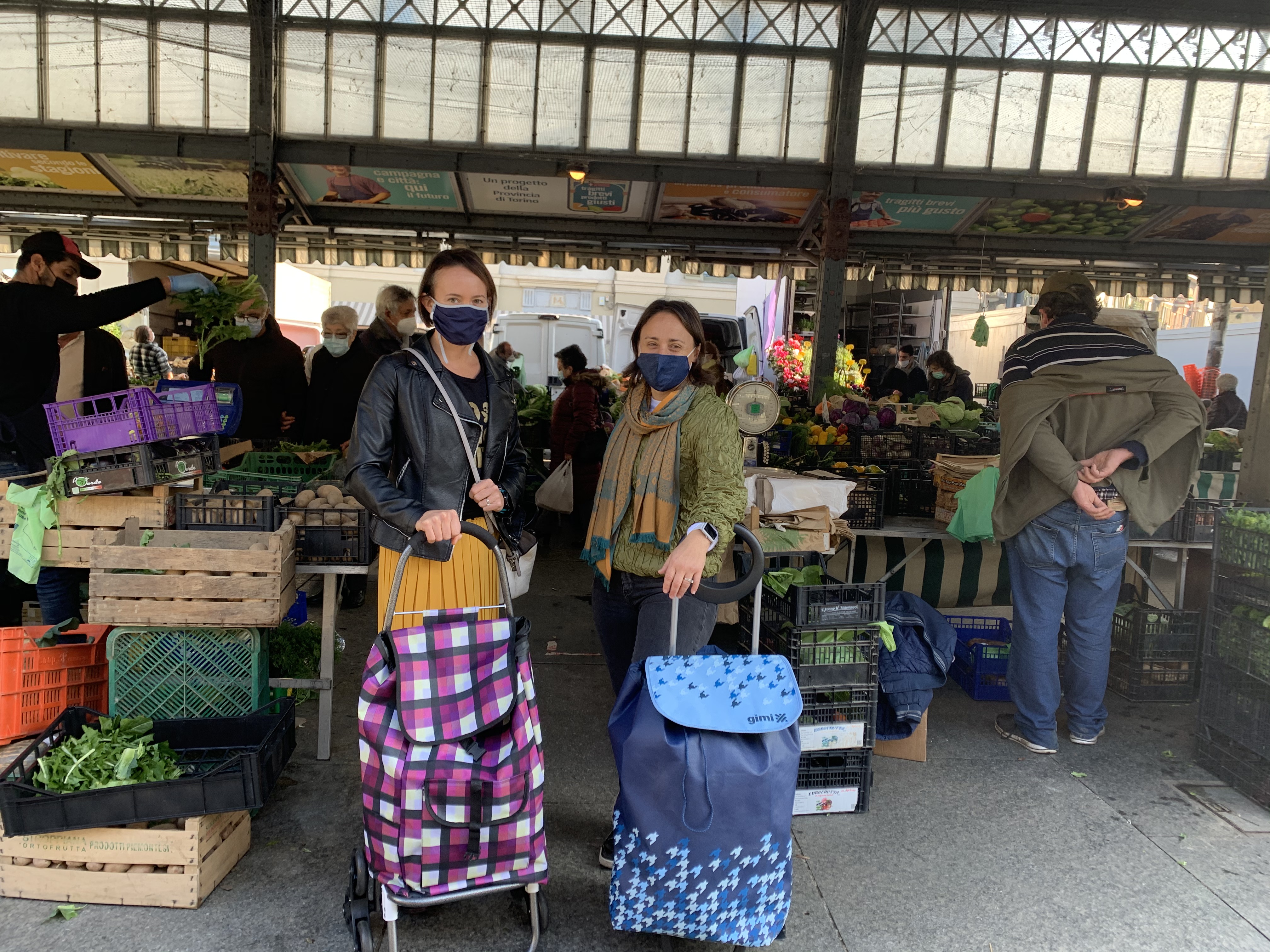
At the contadini (small, local farmers) section of the large Porta Palazzo market in Turin with my friend Erin

Buon Viaggio! Our Story of Leaving Chicago

As we sit here in the waiting area at 9 pm at night in O’Hare international airport, I’m not experiencing the typical stresses that most moms feel as they are getting ready to board an overnight flight with three young children. Instead, I feel incredible relief and calmness. The last three weeks have been some of the most emotional of my life. We have been planning this adventure “The Avventura” for almost 5 years and it’s finally here.

It’s been kind of like planning for a big wedding. There are some big decisions to make at the beginning, not much happens in the middle, and then the shit really hits the fan right at the last minute. But in the end, the payoff of all of those plans is fun and life-changing and so worth it.

Three weeks prior, we quit our jobs and sold our house and car, but we were still waiting for our visas. I was on an emotional roller coaster because I had to tell so many of my veterinary clients with whom I’ve had amazing relationships over the years that I was leaving and I would really miss them and their pets, but I was also so excited about my plans with my family. I was so worried about whether we will obtain the visa that I had a constant ball of stress in my stomach. I wasn’t sleeping well at night and mostly was just really tired. I was caught up in the logistics of leaving and not really present in my life. 

Two weeks before, I woke up one morning (after 3 hours of sleep) and decided we could no longer wait for the consulate to call us to give us information about our visas. We showed up at the office requesting information. We were told that it was not possible to approve our visas. Panic set in and we started begging and negotiating. Dave was nervous. Dave is NEVER nervous. I freaked out. We had lots of conversations, provided more paperwork and two days later, the visas were approved. I shed tears for the first time in this adventure as we left the office. I cannot explain the relief.

One week out, we had birthday/going-away parties for all three of our children individually (seriously) and we had both sides of grandparents in town to say goodbye. We also started serious preparations to move out. We made the decision to not store anything. We sent a small number of our belongings to Vermont with my parents to store at my brother’s house, but we got rid of a lot of stuff. We only ended up taking about 50% of our belongings with us to Italy. I was shocked at the size of the moving truck. It was a 20-foot container with room to spare. We only took what we really love and need. The experience of figuring out what that is (with 3 children) was in and of itself cleansing.

Then, comes the blissful ending. We moved out of our house and were staying with a dear friend in Chicago for the last 5 days. We spent the mornings, afternoons, and late nights with the people we really love that helped us make Chicago our home for the last 9 years. We ate at every one of our “favorite” places and saw many of our “favorite” people. I shed more tears but enjoyed lots of smiles and hugs. I felt so much love and I know that our family can do this.

So, as we board our plane to Frankfurt and then onto Turin, I feel an incredible sense of calmness and capability. I feel that we have truly accomplished the “hard” part. Making the plan, executing the plan, and then having to say goodbye. What comes next…who knows, but I know it will be an avventura.